Why Vendor Discovery in STR Is Still Surprisingly Random
Why vendor discovery in short-term rentals is still surprisingly random — and why a structured approach to finding the right tech partners matters.
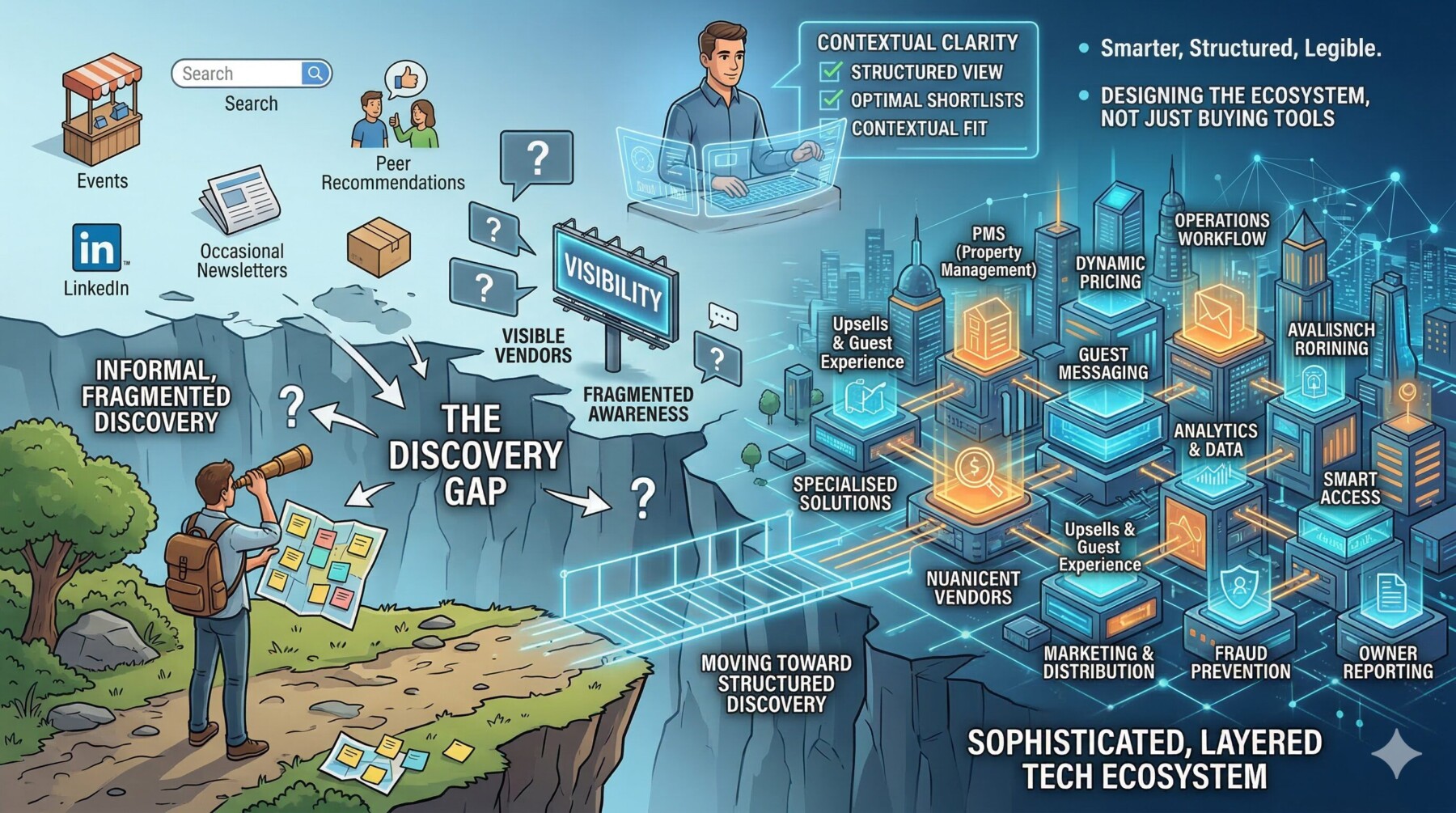
For an industry that now has a relatively sophisticated technology ecosystem, vendor discovery in short-term rentals remains remarkably informal.
This is one of the sector’s strangest disconnects.
On one hand, the market has become richer, more specialized, and more stratified. Buyers face a wider array of categories, more nuanced differences between vendors, and greater dependency on how systems interconnect. On the other hand, the mechanisms used to discover those vendors often remain surprisingly rudimentary.
Trade shows. Online search. Peer recommendations. LinkedIn. The occasional newsletter. Vendors you’ve heard of.
None of these channels is useless. In fact, each carries real value. Trade shows are one of the few places where context-rich conversations can happen quickly. Peer recommendations carry credibility because they come from concrete operational experience. Online search remains a natural starting point. LinkedIn is useful for surfacing trends, launches, and discussions.
The problem isn’t that these channels fail entirely. The problem is that they don’t constitute structured discovery.
Fragmented Discovery Shapes the Market
They create awareness in fragments. An operator meets a vendor at a conference. Another gets mentioned by a colleague. A third appears constantly because it has greater marketing visibility. A fourth emerges from a professional conversation. A fifth never makes the shortlist — not because it isn’t relevant, but because it never enters the field of awareness in the first place.
This isn’t a trivial problem. It shapes the market.
When discovery is fragmented, visibility becomes a more powerful force than relevance. The vendors buyers see most often are more likely to be evaluated, whether or not they’re the best fit for a given operational model. Meanwhile, more specialized or less visible solutions can remain largely hidden from the businesses they’d actually suit best.
This has consequences on both sides.
Visibility and Relevance Are Not the Same Thing
For operators, the risk is that decisions about their tech stack get made within a narrower field of vision than what the complexity of their business actually demands. They may build functional shortlists, but not necessarily optimal ones. The ecosystem they explore isn’t the ecosystem that actually exists; it’s the subset that emerges from their discovery channels.
For vendors, the challenge is equally significant. Product quality alone doesn’t guarantee market understanding. A company can solve a real operational problem and yet struggle because its visibility is inconsistent, its positioning too generic, or its relevance not clearly legible to the buyer.
This is one of the reasons vendor competition in short-term rentals can feel strangely distorted. Companies aren’t always competing on the basis of pure product fit. They’re often competing in an awareness environment shaped by events, budgets, timing, relationships, and algorithmic visibility.
This Makes the Market Less Efficient Than It Looks From Outside
It also creates a subtler problem: buyer education remains incomplete. In such a stratified ecosystem, discovery should ideally help operators understand categories, relationships, and context. Instead, it often delivers disconnected product encounters. Buyers become aware of companies, but not necessarily of the market structure itself.
This is why vendor discovery in short-term rentals still feels surprisingly random. It’s not random in the sense of arbitrary. It’s random in the sense of incomplete, uneven, and overly dependent on where the buyer looks, who they know, and which vendors are most visible in those pathways.
Once the ecosystem becomes large enough, discovery stops being a secondary topic. It becomes a piece of how the market functions. If operators can’t easily grasp the field of relevant options, and if vendors can’t be easily found by the buyers they’re genuinely designed for, then the ecosystem operates below its potential.
The next phase of short-term rental maturity will likely demand that discovery become more structured, more legible, and more contextual than it is today.
Not just louder. Smarter.
Think about how you currently discover your vendors. Think about how complete your market view really is.
Follow SCALE Connect on LinkedIn
Sign in to read the full article
Create a free account or sign in to get full access to Scale Wire's reporting, market data, and industry analysis.
About the author

Gianpaolo Vairo
Co-Founder
Instead of just following the short-term rental market, I help architect its future. Recognized among the Top 20 Influential People in VR Tech, I have spent the past 15 years empowering tourism brands
View profileMore from Scale Wire

Serviced Accommodation Is Growing in Europe. Should STR Property Managers Be Paying Attention?
Nearly 20,000 new rooms are set to open across Europe over the next five years. Here's what STR operators need to know before treating it as a diversification opportunity.

How technology became the backbone of the Short-term Rental industry
Why your tech stack now runs everything behind every guest stay, and how to choose wisely

Brussels Readies Clearer Rules for Cities to Curb Holiday Lets
The European Commission is preparing an Affordable Housing Act that would give cities and regions clear criteria to restrict holiday lets, aiming to end years of legal limbo over what counts as proportionate.

The €1.2 Billion Shift: Why Aparthotels Are Capturing Europe's Accommodation Market
€1.2bn flowed into European serviced apartments in 2025 as regulation reshapes the market.